
Inside Kreygo
The page we write before the agent: what it will not do
Before we build an agent we write down what it will not do. Why that list matters if you are buying one.
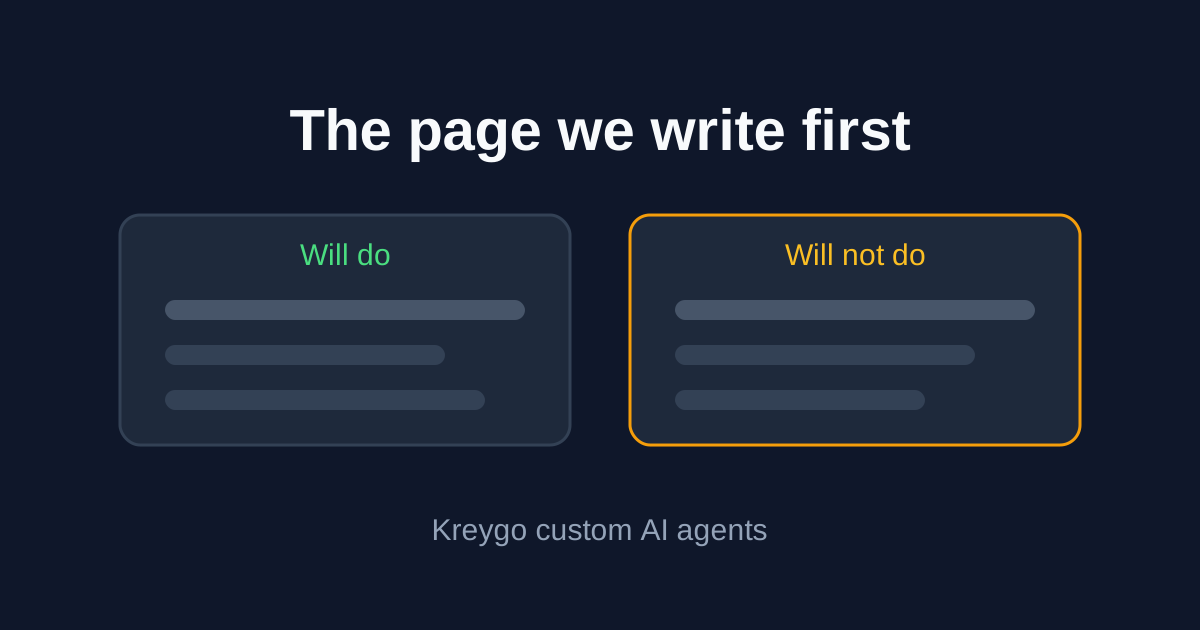
Ask most people what they want from an AI agent and they will tell you what it should do. We start somewhere else. In discovery, the first step of every project, we talk through your workflow and your goal, and we write down what the agent will not do.
That list is easy to overlook. It is also one of the most useful pages in the project.
Here is why. An agent that is vague about its limits is hard to rely on. If nobody has said where it stops, you find out where it stops when something goes wrong. A written "will not" list is a list you can read in advance and check our work against.
It also keeps the work honest. We build custom agents, or small teams of agents, around how a business already works. We do not sell off-the-shelf packages, so every agent starts from your way of doing things. That means the boundaries are yours too: what you are comfortable handing over, and what you are not.
The order of events matters. After discovery comes a proposal with a written scope and a written quote, and nothing starts until it is agreed in writing. Only then do we build. So by the time anyone writes a line of agent, the yes list and the no list are both on paper, and both sides have seen them.
There is a human end to the process as well. It finishes with handover, which is the client's sign-off. The person who has to live with the agent gets the last word.
None of this is exotic. It is closer to how a good contractor works: agree the job, agree what is out of scope, put it in writing, then start. What is different is that people often skip the out-of-scope part when the thing being built is software that seems capable of anything. We would rather say plainly what it will not do than leave you to guess.
A fair question is whether a "no" list makes the agent less useful. Our view is no. A clear boundary is what lets you give it real work. We cannot promise outcomes here, and we will not try. We can promise that the limits will be written down before anything starts.
If you have a task you would like off your team's plate, tell us about it. We will say whether an agent fits, and, if it does, what we would write on that page.